
Shopping Cart
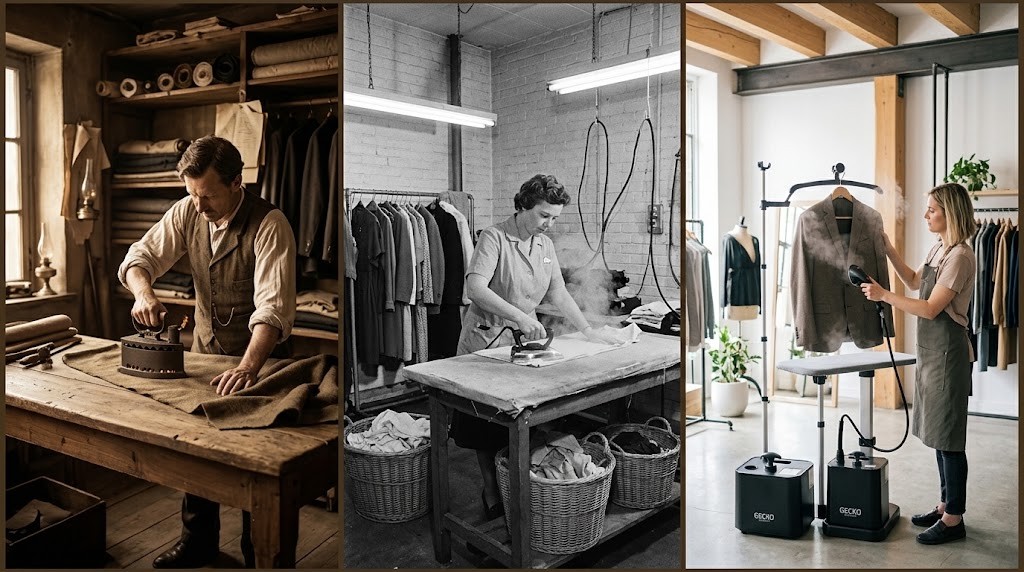
This technical analysis presents Gecko-Steamer®’s operational perspective on commercial and residential clothes steaming, developed by Salamandres Developpement. It is grounded in the direct field engineering of its founder Laurent Depaepe, hands-on feedback from fashion professionals and private users, and more than 30 years of designing and servicing specialized steam solutions since 1994.
Introduction
Clothes steaming is often presented as a simple, universal alternative to ironing. In reality, it is highly effective under specific thermal and mechanical conditions and fundamentally unsuitable in others.
At Gecko-Steamer®, our technical position is built on over 30 years of continuous manufacturing experience. It relies directly on real-world operational feedback from our clients —first high-volume retail stores and costume ateliers, followed by demanding residential users. Practical field constraints have shaped our boiler engineering and product architecture.
This page has a deliberately clear goal: to explain objectively how steam interacts with textile fibres, what vertical steaming can and cannot achieve, and how to select the right equipment architecture based on actual workflow.
Summary
- Engineered clothes steaming is a complete fabric-finishing technique : the combined action of temperature and steam flow relaxes polymer bonds without abrasive mechanical compression.
- Continuous low pressure : the industry standard for retail stores to eliminate packaging creases from new garments rapidly without risk of glazing.
- Multi-position high pressure (e.g., Gecko-Steamer MP900) : unifies vertical steaming and horizontal pressing to fully replace a conventional steam generator iron on laundered home clothes.
- Commercial high pressure (e.g., Gecko-Steamer G800) : engineered for heavy drapery, interior design, tufted upholstery, and hospitality settings.
| Technology | Pressure & Steam Profile | Recommended Application | Reference Architecture |
|---|---|---|---|
| Continuous Low Pressure | Continuous free-flow (~40 g/min), open atmospheric boiler | Apparel stores, showrooms, ready-to-wear backrooms, new stock processing | Commercial Free-Flow Series |
| Multi-Position High Pressure | Pressurized vessel (up to 4–5 bars) + multi-angle ironing board | Residential: complete iron replacement, dual vertical and flat finishing | Gecko-Steamer MP900 |
| Specialized Commercial High Pressure | Industrial pressure boiler + extended wand | Upholsterers, luxury hotel drapery, theater sets, heavy dense fabrics | Gecko-Steamer G800 |
What is clothes steaming, in practical terms?
Clothes steaming is a thermo-hydric fabric restoration process designed to respect the textile structure while eliminating creases with minimal mechanical stress.
The principle relies on vertical application : the garment or textile hangs freely under its own gravitational weight. Moisture and thermal energy penetrate the weave, temporarily breaking the hydrogen bonds holding the tangled fibres together. The fabric relaxes naturally without aggressive friction.
This makes steaming particularly suitable for garments , tailored pieces , and suspended interior textiles (curtains, drapes, wall fabrics). Conversely, handling large flat household linen (sheets, tablecloths) without a supporting board remains inefficient, requiring dedicated horizontal pressing.
When clothes steaming is relevant
Steaming is uniquely effective when dealing with fine or fragile textiles sensitive to direct pressure or excessive heat.
It is equally suited when the required aesthetic does not call for an artificial, razor-sharp pressed fold, but rather a clean, natural drape preserving the textile's original volume.
Delicate textiles
A textile requires specialized steaming for two distinct structural reasons:
First, it may feature a thermo-sensitive fiber : silk, fine wool, cashmere, viscose, or technical synthetic blends, which crush or glaze under the mechanical friction and dry plate contact of an iron.
Second, it may be delicate due to its architectural construction : pleating, lace, embroideries, beadwork, or structured jackets, which cannot be laid flat without risk of distortion.
Steaming provides the optimal solution because it acts without abrasive plate pressure , permanently avoiding shine marks, flattened velvet pile, and melted synthetic yarns.
Professional or semi-professional use
In retail and commercial environments, garment steaming serves an exacting operational goal: presenting collections in pristine condition without risking product markdown.
In stores, showrooms, and wardrobe departments, merchandise presentation directly drives brand equity. The absence of heavy soleplate friction prevents scorch marks, discoloration, and structural damage, directly preserving inventory value.
From an operational standpoint, steaming delivers unmatched labor efficiency : rapid turnaround per garment, zero training barrier for store associates, and seamless shift-after-shift operation.
Finally, choosing heavy-duty equipment developed by Salamandres Developpement guarantees a controlled total cost of ownership (TCO) through modular, fully repairable components and continuous spare parts availability.
The real limits of clothes steaming
The limits of clothes steaming are governed entirely by the initial mechanical condition of the textile fibres .
In retail stores, teams work predominantly with new garments : the fabrics retain their industrial finishes and sizing agents. Creases are superficial folds caused by box packaging and transport. Under these conditions, a stable steam flow removes creases within seconds.
At home, clothes have undergone wear, laundering, and high-speed spin cycles (1,200+ RPM) that physically twist and crush internal fibers. While vertical steam relaxes the garment, it cannot repair broken fibres or flatten severe wash-set folds without the aid of soleplate heat against a firm pressing surface.
Steaming acts on the geometry of the yarn, not on a damaged molecular structure . Once a fiber has suffered chemical or severe thermal degradation, no steam treatment can rebuild it.
A poorly engineered steamer causes more operational frustration than a basic iron. Efficiency depends on boiler design and flow stability.
Home vs professional steamers: it’s about use, not “range”
The distinction between domestic and commercial steamers is an alignment of operational workflows , not a status hierarchy.
In retail stores, the challenge is processing 100 to 300 new hanging garments per day reliably. A continuous low-pressure system (open boiler without solenoid valves) represents the most durable, maintenance-free, and cost-effective choice.
In residential settings, users expect complete versatility: handling delicate silks on a hanger, but also pressing cotton shirts and heavy linens flat. This is where an advanced high-pressure station like the MP900 becomes necessary, merging vertical steaming with the horizontal performance of a steam generator iron.
Why steam pressure can be a game-changer (without miracles)
Boiler pressure (measured in bars) does not press the fabric down: it accelerates steam velocity to drive moisture straight through dense, heavy weaves such as raw denim, canvas, double-faced wool, and upholstery fabrics.
Equally critical is the continuous steam volume (measured in grams per minute). A consistent, high-volume flow ensures steady thermal transfer, allowing operators to work at high speed without wet-water spitting or surface condensation.
How to know if clothes steaming is right for you
Before selecting equipment, assess your operational requirements across four criteria:
- Fabric origin: Are you treating packaging folds on new clothes, or deep spin-cycle creases on laundered laundry?
- Textile density: Are you working with lightweight silks and knits, or dense woolens, denim, and upholstery?
- Desired finish: Do you require a soft, natural retail drape or razor-sharp horizontal creases on collars and cuffs?
- Duty cycle: Is the unit intended for non-stop commercial store operation or versatile weekly household sessions?
Conclusion
Equipment perceptions have evolved significantly. Long viewed as a secondary touch-up tool, modern steaming now provides complete textile finishing, notably through multi-angle high-pressure systems.
This evolution expands textile possibilities without turning steam into an indiscriminate cure-all. Each technology fulfills a specific mechanical role.
At Gecko-Steamer®, our engineering starts from authentic field usage: guiding clear choices between continuous low-pressure retail systems and high-pressure hybrid stations, grounded in physics rather than marketing promises.
What this page is not
This technical brief is not a commercial sales pitch. Authored from the engineering standards of Salamandres Developpement, it sets out the physical parameters governing how steam interacts with woven and knitted fabrics.