
Shopping Cart
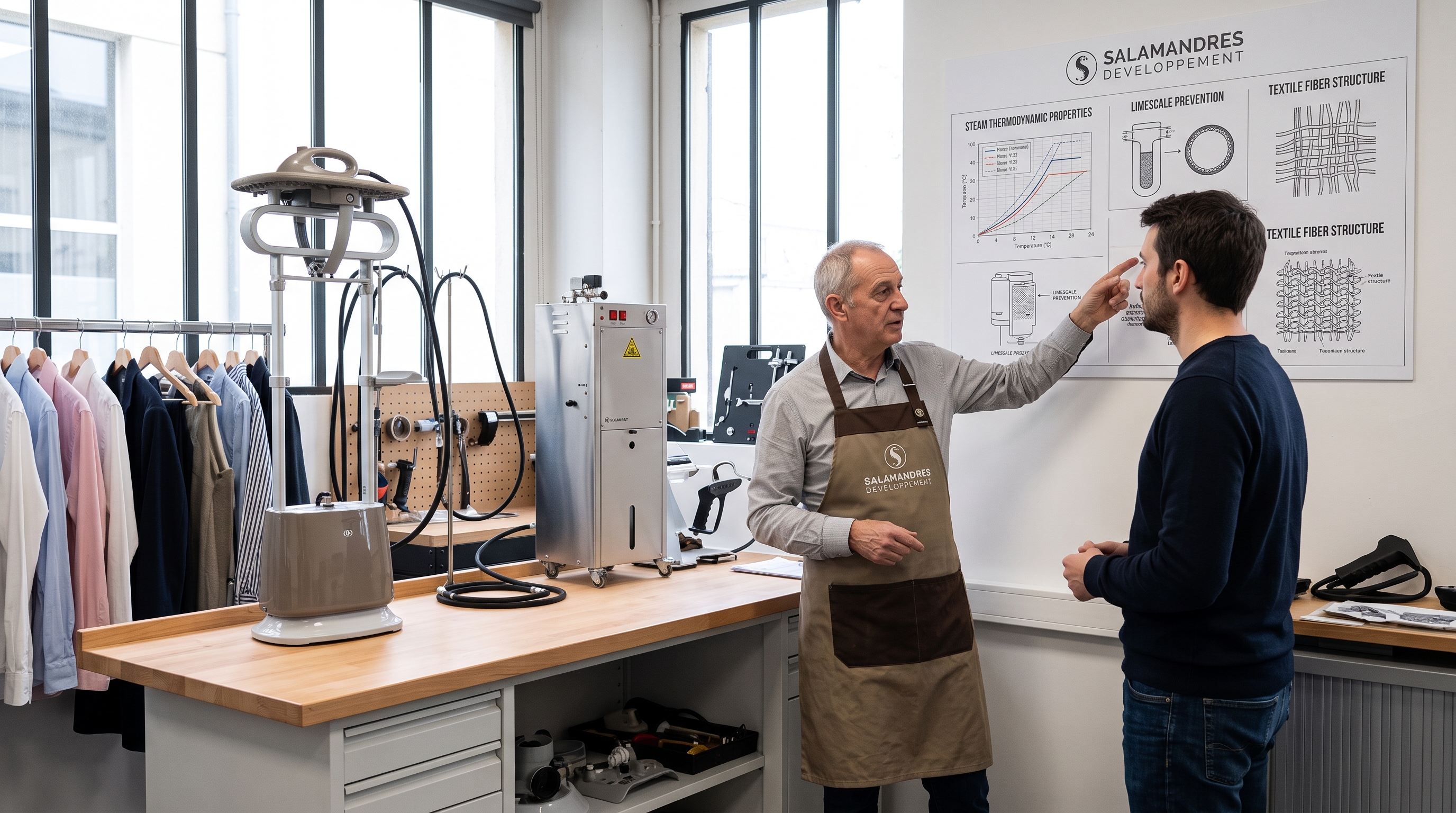
This technical guide brings together answers from our workshop to the most common questions about steam garment care: steam thermodynamics, equipment selection according to your business sector or domestic use, fibre compatibility, maintenance procedures and limescale management.
For more detailed information on a specific issue, links to our technical engineering guides are provided throughout the answers and at the bottom of the page.
General questions
What is a clothes steamer?
A clothes steamer is an electrothermal appliance designed to relax textiles mainly in the vertical position. By projecting a flow of hot water vapour (from 98 °C to over 140 °C depending on boiler pressure), it rehydrates the fibre and temporarily breaks its hydrogen bonds. The textile regains its natural hang and drape under its own weight, without abrasive stress or mechanical crushing.
What is a clothes steamer used for in everyday life?
For fashion and apparel professionals, it instantly removes storage and unpacking creases from garments on hangers before they go on sale, and refreshes pieces handled in fitting rooms without the risk of glazing.
At home, it can be used either as a fast vertical solution for delicate fabrics or as a complete ironing solution when using a versatile high-pressure station equipped for flat work.
Is a clothes steamer really effective?
Yes, provided the technical architecture of the appliance is suited to the mechanical condition of the fabric:
- On a newly unpacked garment or delicate silk, a continuous low-pressure flow is more than sufficient.
- On washed cotton or linen spun in a washing machine (1,200 rpm), only steam under 4 to 5 bar of pressure has the kinetic energy required to pass through the thickness of the fabric.
Is a clothes steamer suitable for occasional or intensive use?
Our appliances are calibrated for specific usage profiles. A professional low-pressure model uses an industrial aluminium boiler and direct connections to operate for 4 to 8 hours a day in store. A domestic high-pressure model is designed for 30- to 60-minute sessions at maximum thermal pressure.
Choosing & sizing
Which clothes steamer should I choose?
Base your decision on the mechanical condition of your laundry rather than electrical wattage alone:
- Fashion boutique: professional low-pressure clothes steamer with continuous refill (speed, simplicity, express descaling).
- Home & washed wardrobe: high-pressure station with regulated heated soleplate (e.g. MP900) to handle both spun cotton shirts flat and delicate dresses vertically.
For more detail: Which clothes steamer should you choose for your use?
What is the difference between a domestic clothes steamer and a professional model?
A modern domestic clothes steamer uses a sealed pressurised boiler (4 to 5 bar) and a heated iron soleplate to overcome creases in machine-spun laundry.
A professional clothes steamer prioritises continuous free-flow steam, a large removable water tank and high mechanical tolerance of tap water so garments can be processed without interruption.
Which clothes steamer is best for the home?
For complete domestic use, a hybrid high-pressure station is the most rational solution. It allows delicate garments to be hung for a quick 45-second vertical refresh while also providing a multi-position ironing board for collars, cuffs and bed linen with the efficiency of a steam generator.
Which clothes steamer should I choose for a fashion boutique?
The in-store reference remains the continuous-flow low-pressure vertical steamer (GK30 / LM series). It operates without pressurising a sealed tank, accepts tap water, heats up in 45 seconds and allows immediate water refill without waiting for the appliance to cool.
Read more: How should you choose a professional clothes steamer for your activity?
Comparison questions
Clothes steamer or iron: what is the real mechanical difference?
An iron flattens fabric through hot mechanical pressure (pressure and friction at 150–200 °C), which can create shine on dark fibres and flatten the yarn structure.
A clothes steamer relaxes the yarn by adding steam without aggressive friction. With the arrival of high-pressure hybrid stations with integrated boards, the boundary has narrowed: vertical fibre care can now be combined with precise crease setting when working flat.
Full dossier: Comparison: clothes steamer or iron — which should you choose?
Can a clothes steamer replace an iron?
A vertical low-pressure model does not replace an iron on heavily creased washed laundry. A high-pressure hybrid appliance such as the Gecko-Steamer MP900, however, can fully replace a steam generator: its 5 bar pressure and hot metal soleplate form crisp creases flat while retaining the speed of vertical steaming on a hanger.
Textiles & safety
Which textiles can be steamed?
Almost all clothing fabrics: wool, cashmere, silk, viscose, chiffon, polyester, velvet, linen and cotton. Steam acts without direct thermal burning.
Exceptions: genuine leather, suede, and coated waterproof or non-breathable plasticised materials should not be treated with direct steam.
Can you steam thick jeans or a cotton shirt?
Yes. For washed and spun denim or cotton poplin, the steam must be expelled under high pressure to penetrate the thickness of the yarn. The combination of a pressurised jet and contact with a heated soleplate smooths these rigid fabrics effectively.
Can you steam installed curtains or furnishing fabrics?
Yes, this is one of the strengths of vertical steaming. Curtains and sheers can be treated directly in place on the rail. For heavy fabrics or high ceilings, a long-reach high-pressure model such as the G800 provides constant steam projection without thermal loss.
Does a clothes steamer pose a risk to delicate garments?
No. The absence of mechanical rubbing and the presence of hydrating steam avoid the risk of surface scorching or glazing (shiny marks on dark woollens and synthetics).
Practical questions, water & maintenance
What water should I use in a clothes steamer?
The rule depends strictly on the heating technology:
- High-pressure appliances (pressurised tank or conductivity sensor): use only demineralized water specially formulated for steam generators (with conductive additive). Tap water is strictly prohibited to prevent limescale deposits on the level sensor and blockage of valves.
- Continuous low-pressure appliances (store series): tap water is fully tolerated, provided the appliance is drained and descaled regularly with 14° white vinegar.
How should I maintain and descale the appliance?
Maintenance is based on periodically dissolving limescale before it turns into hard calcite:
- Fill the circuit with a 50/50 mixture of water and 14° household vinegar (or a specialist steam-boiler descaler).
- Warm for 30 seconds, switch off the heat and leave to act for 30 minutes.
- Rinse thoroughly with clean water through two consecutive drain cycles.
Step-by-step guide: Descaling and repair guide
Why is my clothes steamer spitting boiling water?
This symptom most often indicates limescale build-up: the scale layer insulates the heating element, the steam lacks sufficient heat energy and condenses inside the hose. On a high-pressure model, limescale can also blind the water-level sensor or block the relief valve, causing overfilling that floods the steam chamber.
How long does it take to steam a garment?
Allow around 30 to 45 seconds to steam a jacket, light dress or top on a hanger. For a washed cotton shirt treated flat with a high-pressure appliance, allow 2 to 3 minutes for an impeccable finish on collars, cuffs and button plackets.