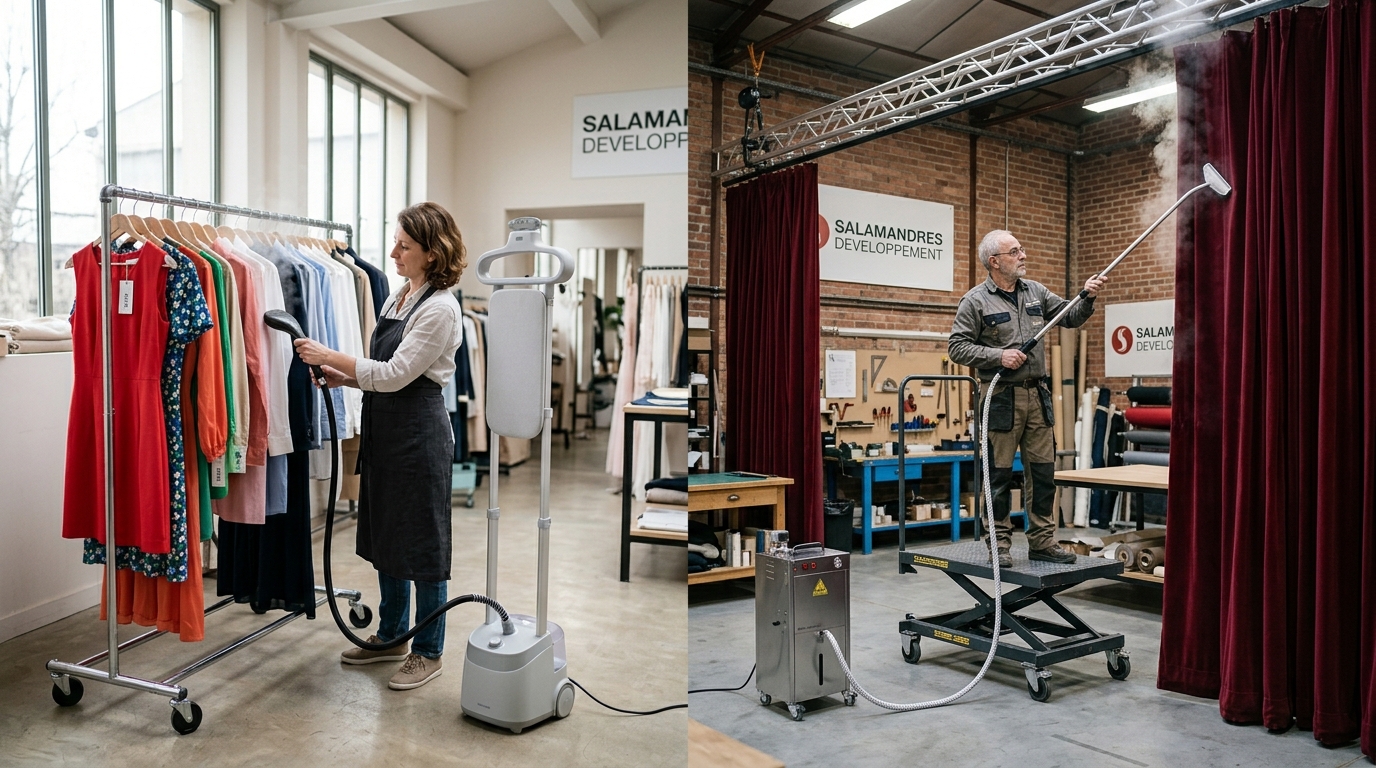
Professional comparison between a low-pressure clothes steamer for fashion retail and a high-pressure steam generator for curtains and furnishing textiles

Technical guide produced by the Gecko-Steamer® workshop, a brand developed by Salamandres Developpement. Since 1994, under the direction of its founder Laurent Depaepe, we have equipped European fashion retailers, garment workshops, hotels and costume departments with thermal solutions designed around their operating profitability.

Choosing a professional clothes steamer does not mean blindly selecting the appliance with the highest nominal pressure. In a commercial operating environment, the rational choice depends above all on your actual activity: the type of textiles handled, hourly workload, the skills of rotating teams and control of water quality.

A fashion store, a temporary retail corner, an upholsterer-decorator, a hotel laundry or a theatre costume department do not face the same workflow constraints. They do not use steam in the same way and should not have to bear the same equipment downtime costs.

The term “professional” covers two opposite technical realities

In thermal equipment, the term “professional” does not describe one universal machine. It separates two distinct types of use:

  • Rapid finishing of new garments on hangers: high throughput, surface steaming of storage creases without residual moisture, immediate availability 8 hours a day.
  • Deep treatment of heavy or suspended fabrics: high curtains, furnishing velvet, stretched wall textiles or thick stage costumes requiring steam projected under boiler pressure.

A sound professional investment is not measured by the prestige of the specification sheet, but by the exact match between the appliance’s thermodynamics and your working pace.

In new-fashion retail: low pressure is the rational standard

In a clothing store, sales showroom or independent boutique, collections unpacked from cartons are factory new. Garments need rapid removal of transport creases, but they do not have the rigid fibre breaks caused by domestic washing-machine spin cycles.

In this commercial environment, a professional continuous low-pressure clothes steamer is the most profitable and reliable production tool:

  • Immediate operational availability: 45-second heat-up and continuous tank refill without switching the appliance off or waiting for pressure to fall in a sealed boiler.
  • Simple operation: no complex trigger or delicate setting for sales teams or seasonal staff.
  • Complete textile safety: regular atmospheric flow with no risk of wetting the garment or scorching delicate synthetics.
  • Maximum water tolerance: Gecko-Steamer low-pressure generators accept mains water and can be descaled in the workshop by simple rinsing with 14° white vinegar.

For intensive commercial use on new garments, continuous low pressure is the most economical and durable technical foundation.

This is the technical DNA of our Gecko-Steamer® retail range: the GK30, LM44, LM58 and LS98 are sized for continuous collection-unpacking cycles without solenoid-valve failures.

High pressure in retail: real advantages and operating constraints

Some retailers nevertheless choose high-pressure equipment for their stores. This choice offers visible advantages: the pressurised jet (4 to 5 bar) is more spectacular, penetrates fabrics faster and compensates for less disciplined steaming technique.

However, this additional power imposes strict logistical constraints in store:

  • Heat-up and refilling time: a closed pressurised boiler needs several minutes to reach operating temperature and requires a strict safety procedure when refilling.
  • Absolute water requirement: tap water is strictly prohibited because it can cause repeated electronic failures by blinding the water-level sensors.

In a clothing boutique, high pressure is not the default rule. For the vast majority of retail volumes, low pressure remains faster to deploy, much more economical to purchase and maintain, and far more tolerant of handling mistakes.

When high pressure becomes essential in a professional environment

Sealed-pressure technology becomes essential as soon as textile type or spatial configuration goes beyond garments hanging on a retail rail:

  • Upholsterers, interior decorators and curtain installers: vertical in-situ steaming of lined curtains, weighted sheers and wall hangings.
  • Housekeeping teams and hotel laundries: touch-ups on bed skirts, upholstered headboards and decorative textiles without dismantling.
  • Theatre, opera and film costume departments: maintenance of multi-layer period costumes, heavy tweeds, brocades and rigid uniforms.
  • Dry cleaners and alteration workshops: need to combine high-throughput vertical steaming with precise horizontal crease setting.

For these demanding professions, our high-pressure model Gecko-Steamer G800 is the reference tool. Equipped with a long diffuser lance, it projects steam to more than 2.50 metres in height without thermal loss or liquid condensation on the work.

The decisive factor: water management and staff

In a business environment, the no. 1 technical criterion for deciding between low and high pressure is your ability to control water supply:

Workshop operating rule: If your appliances are handled by rotating staff and you cannot guarantee exclusive use of demineralized water for steam generators, high pressure must be ruled out.

Why? Because a pressurised boiler supplied with hard water rapidly develops limescale on the level sensors and blockage of the balancing valves. The financial consequences are immediate: boiling-water backflow onto textiles, thermal safety shutdown, workshop downtime and direct operating loss.

Across a multi-store fleet, a low-pressure steamer running on tap water delivers an unbeatable total cost of ownership (TCO).

Why using a domestic appliance in a business is a costly mistake

To reduce initial investment, some managers are tempted to equip stores with domestic steam generators or consumer steamers bought through mass retail. In the field, this calculation ends in technical and legal failure:

  • Component failure: a domestic appliance is calibrated for 1 to 2 hours of weekly use. Subjected to 4 hours of daily operation, its pumps and electronic boards fail prematurely.
  • Loss of manufacturer warranty: using consumer equipment in a professional commercial setting constitutes non-compliant use and invalidates contractual warranty coverage.
  • Workplace safety and compliance: power cords, thermal insulation and housings of domestic appliances are not designed to the same mechanical-resistance requirements expected in public-access commercial premises.

Decision matrix: which equipment for your trade?

Operational reference to size your steam fleet according to your workflow:

Fashion boutique

Textiles & constraints: New garments unpacked, continuous replenishment, sales teams

Recommended technology: Professional low pressure (GK / LM Series)

Workshop rationale: 45 s heat-up, non-stop refill, accepts tap water, minimal operating cost.

Corner, showroom & fashion shows

Textiles & constraints: Careful presentation, express touch-ups on rails

Recommended technology: Professional low pressure

Workshop rationale: Immediate handling with no risk of operating error or fabric glazing.

Upholstery & interior decoration

Textiles & constraints: Lined curtains, velvet, high in-situ wall textiles

Recommended technology: Professional high pressure (Gecko G800)

Workshop rationale: Powerful remote projection via long diffuser, penetrates heavy fabrics.

Stage costumes (Theatre, Opera, Film)

Textiles & constraints: Complex materials, dense woollens, period pieces

Recommended technology: Professional high pressure (G800 or MP station)

Workshop rationale: Extreme thermal versatility and strong flow for relaxing heavy fabrics.

Hotel housekeeping

Textiles & constraints: Hanging linen, in-room sheers, headboards

Recommended technology: Professional high pressure (G800)

Workshop rationale: Strong thermal treatment and efficient work without removing curtains.

Boutique without demineralized-water management

Textiles & constraints: Tap water only, maintenance delegated to sales staff

Recommended technology: Low pressure mandatory (LM / LS Series)

Workshop rationale: Avoids severe limescale failures associated with sealed pressurised boilers.

Profitable professional equipment is equipment matched to the skills of its users and to the chemistry of the water available on site.

In summary: equipment matched to your business model

For more than 80% of fashion stores, professional low pressure is the most rational, robust and straightforward solution for daily operation.

For decoration, curtain, hospitality and entertainment specialists, professional high pressure is required to overcome dense materials and work at height.

Equip your business