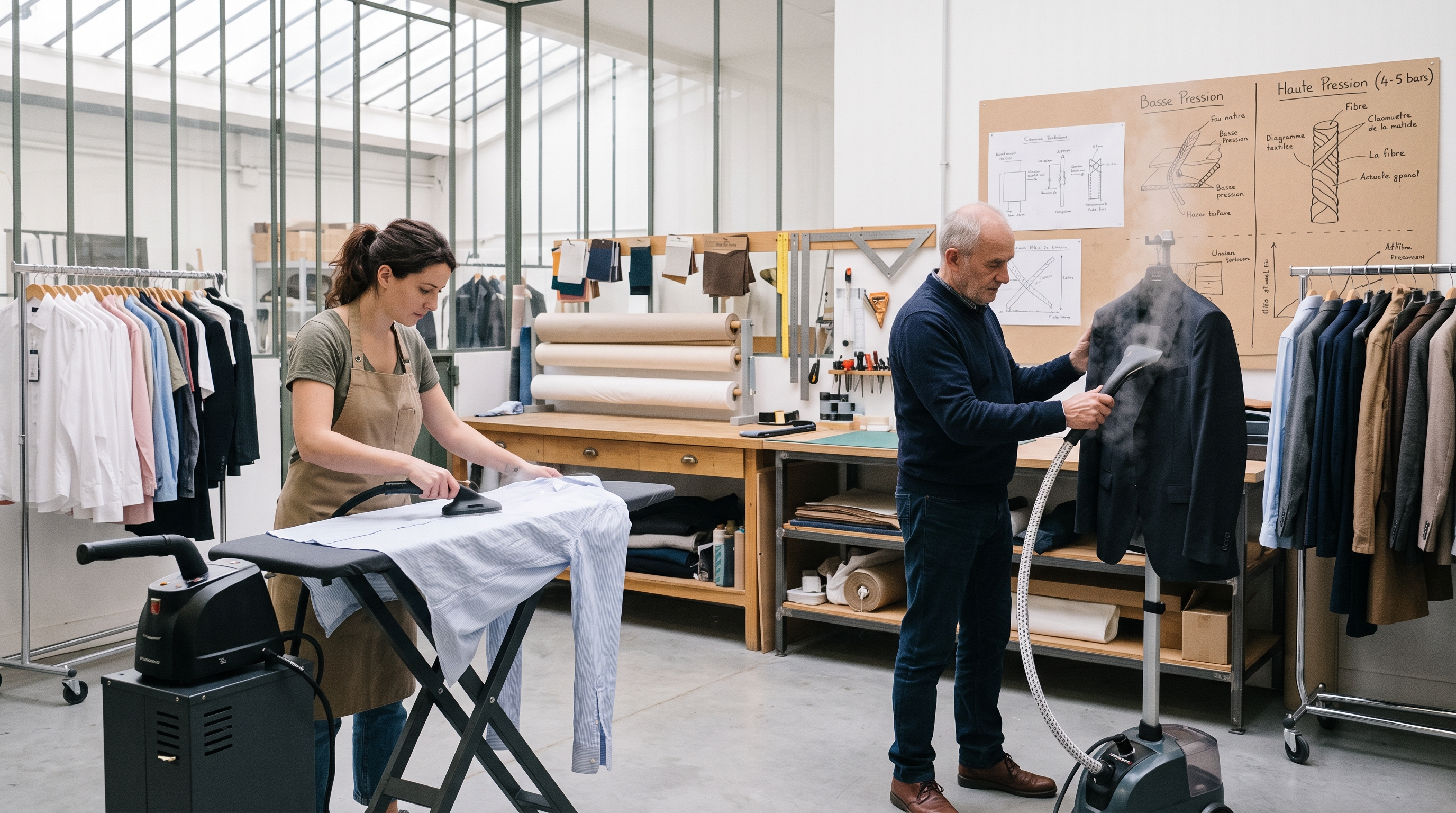
In the Salamandres Développement technical workshop (Gecko-Steamer), a woman and a man test and compare a hybrid high-pressure clothes steamer on a board and a professional vertical clothes steamer on a hanger in front of textile diagrams

This technical selection guide is published by Gecko-Steamer®, a brand developed by Salamandres Developpement. Since 1994, under the direction of its founder Laurent Depaepe, our design office has developed professional and domestic steam equipment around the real constraints of textile fibres.

Choosing a clothes steamer is not simply a matter of comparing electrical power in watts, tank sizes or price-positioning levels. The right choice depends above all on your actual use and the mechanical condition of the textile: garments already worn, washed and spin-dried at home, rapid reshaping of new garments unpacked in store, or specific requirements for hanging curtains and furnishing fabrics.

At Gecko-Steamer®, we distinguish three objective equipment approaches:

  • Demanding domestic use, to fully replace traditional ironing and work both flat and vertically on machine-spun laundry;
  • Standard professional use (retail), to continuously remove transport creases from new garments without risk of glazing;
  • Specific professional use, when steam pressure and jet reach must meet the constraints of furnishing fabrics or hospitality applications.

This page has one clear objective: to help you select the exact technical architecture for your workflow, without investing in an oversized or unsuitable solution.

1. For genuinely satisfactory domestic use: high pressure is the consistent solution

At home, textiles are not in the same mechanical condition as they are in a fashion boutique. They have been worn, washed and subjected to the centrifugal forces of drum spinning (1,000 to 1,400 rpm). The hydrogen bonds in plant fibres (cotton, linen) are compressed: creases are deep, set into the fabric, and the expected finish is high.

In this context, a simple low-pressure vertical flow relaxes the surface of the fabric but does not remove washing creases. Modern domestic equipment must be able to steam everyday garments, press flat where necessary (collars, button plackets, hems), and handle the full range of household laundry.

That is why, at Gecko-Steamer®, we consider that for complete domestic use, high-pressure boiler steam is the only technically satisfactory answer.

Workshop finding

Why no low-pressure steamer is included in our home range

In 2010, the launch of our first online store was aimed exclusively at fashion professionals, giving them direct and responsive access to our low-pressure generators. We had not anticipated the massive arrival of consumers. Private customers immediately bought this workshop equipment... with a clear verdict: nearly 50% returns. Two major physical limitations explain why low pressure is unsuitable for the home.

Failure on machine-spun laundry

In store, the garment is new and simply creased from unpacking. At home, the textile undergoes the severe mechanical compression of spinning (1,000 to 1,400 rpm) and dries compacted inside the drum.

Against these compressed and hardened fibres, a free steam flow at 100 °C with no kinetic energy slides over the surface without ever relaxing the material in depth. Treating spun laundry requires the penetrating power of a pressurised boiler (4 to 5 bar).

Humidity saturation and health risk in an enclosed room

A low-pressure appliance continuously releases steam into the room, even while you reposition the hanger. In a bedroom, dressing room or well-insulated home, this operating mode quickly creates high humidity saturation.

This residual humidity encourages dust mites, increases the risk of wall mould and leaves laundry damp. With a sealed pressurised boiler, the steam is compressed, drier and delivered strictly on demand through the trigger.

The origin of the SP06 Blackstorm and user feedback

Following this finding in 2010, Laurent Depaepe created the SP06 Blackstorm in 2013, the first high-pressure vertical clothes steamer in France. Since this pioneering innovation, our domestic range has continued to evolve through direct user feedback: vertical textile backboards to tension the fabric, multi-position boards to alternate with flat ironing, and heated soleplates to set the finish.

The Gecko-Steamer MP900 illustrates this design: it combines a sealed pressurised boiler (up to 4–5 bar), a regulated heated soleplate for horizontal work and an integrated multi-position board. It performs the functions of a complete ironing and steaming station.

If your objective is to genuinely replace the iron or steam generator at home, alternate between vertical work and flat ironing, and achieve a crisp result on washed textiles, versatile high pressure is the required technology.

2. For a clothing boutique, showroom or corner: low pressure is often sufficient

In a commercial retail environment, the textile issue is different. Garments unpacked from cartons are mostly new. They retain their factory finishes, their original molecular structure and only show superficial folds from packing and transport.

The objective in store is not to flatten washed fabric, but to quickly give garments an impeccable drape on the hanger, maintain a sustained pace (100 to 300 items per day) and provide staff with equipment that is immediately operational, without complex settings.

For this retail use, a professional continuous low-pressure clothes steamer (free flow) is the most rational solution:

  • Immediate availability: refill the tank during use without waiting for a boiler to cool down or depressurise.
  • Mechanical reliability: no solenoid valve exposed to limescale, reducing the risk of equipment downtime in store.
  • Complete textile safety: gentle steam temperature avoiding any risk of glazing dark woollens or scorching synthetic materials.

For intensive use on new garments in store, continuous professional low pressure remains the reference industrial tool.

A private customer who chooses professional store equipment for home use is therefore not making the most relevant choice: they are buying a machine that is highly effective for quickly steaming jackets or hanging silks, but which will show its limits on creased sheets or cotton shirts straight from the washing machine.

3. High pressure in retail: useful in some cases, but not always the best answer

Some stores choose to use high-pressure appliances. This choice can be explained by the need for higher steam ejection speed to penetrate thick denim in a single pass, or to compensate for limited dexterity when handling a vertical steamer.

However, a pressurised boiler in a professional environment requires strict maintenance discipline regarding limescale:

  • Monitoring the quality of the water used (regular rinsing is mandatory).
  • Managing heat-up cycles when several staff members share the equipment without a dedicated maintenance protocol.

In a boutique, high pressure is a powerful accelerator, but it requires more rigorous maintenance than professional free-flow systems.

4. For specific requirements: professional high pressure comes into its own

Professional high pressure becomes essential when the textile being treated is particularly dense or located beyond the reach of a standard hanger:

  • High curtains, drapes and sheers installed in rooms or on stage;
  • High-end hospitality (rapid refurbishment of suites, upholstered headboards);
  • Upholsterers, decorators and furniture professionals (stretched fabrics, furnishing velvet);
  • Costume workshops and theatres where chemical-free thermal sanitation is required.

The Gecko-Steamer G800 was designed for these constraints: paired with a long telescopic diffuser, its high-pressure boiler projects a dense thermal jet more than two metres above the floor, allowing curtains to be steamed and deodorised in place without removal.

Quick selection table

Technical reference points to identify the steam architecture suited to your usage profile:

Your useContext / Textile typeRecommended appliance typeTechnical rationale
Demanding domestic useWorn garments, washed/spun laundry, need for flat and vertical workHigh-pressure clothes steamer with multi-position boardBoiler pressure required to reopen fibres compressed by machine spinning
Home user replacing the ironDaily use, complete wardrobe, sheets, shirtsGecko-Steamer MP900Hybrid station: heated soleplate for collars/creases + fast vertical steam
Boutique, showroom, cornerNew fashion garments, carton packing creases, sustained paceProfessional low-pressure clothes steamerContinuous heating without boiler interruption, no glazing risk, reduced maintenance
High-throughput denim/heavy-fabric boutiqueDense materials, multiple users seeking maximum speedProfessional high pressure (with limescale monitoring)Instant penetration of thick fabrics, requires regular rinsing
Decorators, upholsterers, hospitalityArmchairs, headboards, furnishing velvet, hotel suitesProfessional high-pressure clothes steamerHigh-temperature dry steam to restore loft and sanitise without wetting
Curtains and textiles hanging at heightInstalled drapes, hanging sheers, stage designGecko-Steamer G800 with long diffuserVertical steam reach without heat loss at 2 m height

Choosing Gecko-Steamer® equipment is not about a hierarchy of prestige, but about a strict match between steam mechanics and the physical condition of your textiles.

In summary: do not choose a range, choose an application

The right clothes steamer is not the most expensive or the most imposing: it is the one whose steam production precisely matches the resistance of your creases.

For a household looking to eliminate traditional ironing chores on washed laundry, versatile domestic high pressure (MP900) is the right solution.

For a fashion retailer processing new stock, continuous low pressure remains the most durable and profitable option.

For professionals in textile interiors, hospitality and entertainment, dedicated high pressure (G800) provides the required power and reach.

Go further