
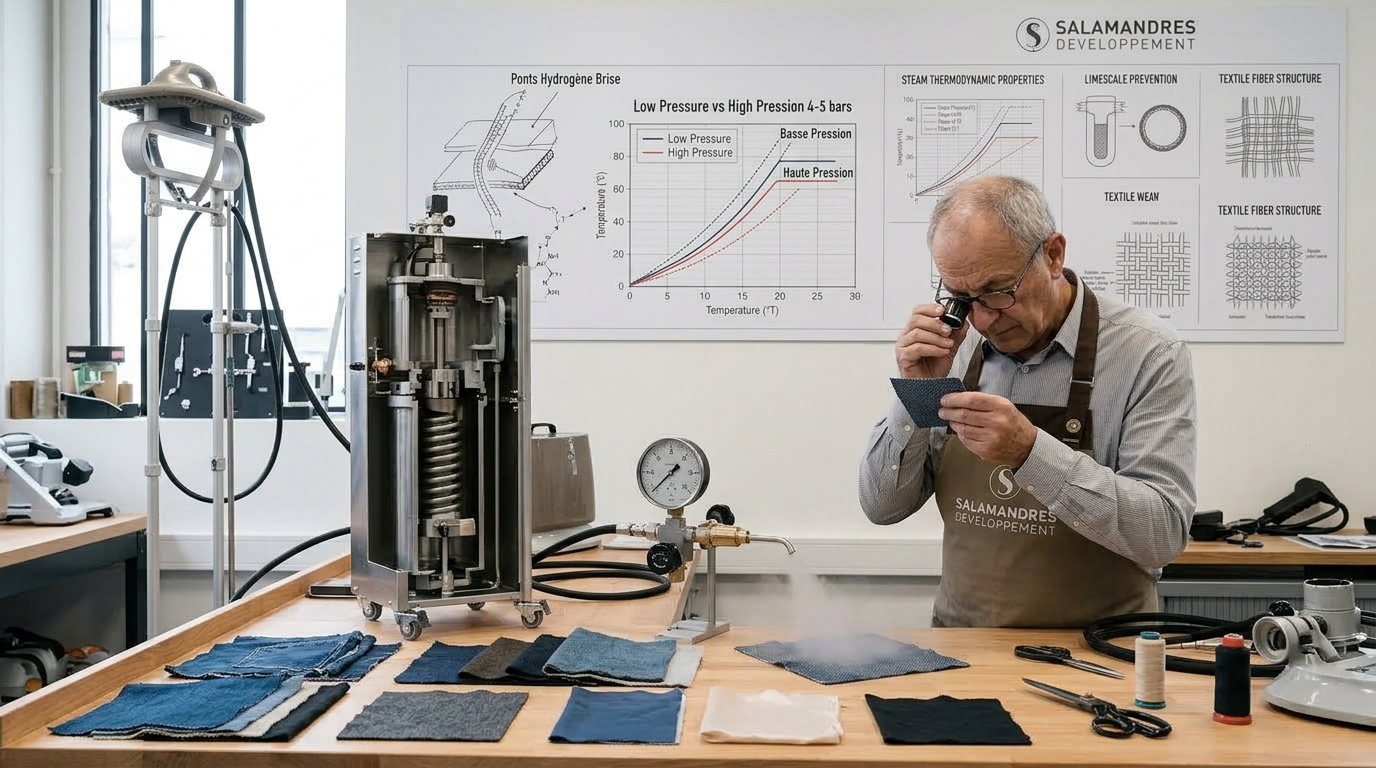
Technical diagram and workshop test bench explaining the thermodynamic action of steam on the hydrogen bonds of textile fibres at Gecko-Steamer

Technical dossier published by the Gecko-Steamer® workshop, a brand developed by Salamandres Developpement. Since 1994, under the direction of its founder Laurent Depaepe, we have studied the thermodynamic action of water vapour on the molecular structure of textile fibres.

A clothes steamer is based on a fundamental physical principle: using the enthalpy and moisture of steam to relax textile fibres without mechanical crushing, removing creases while preserving the garment’s original drape.

Steam physics: molecular relaxation of hydrogen bonds

In a creased fabric, textile polymer molecules (cotton cellulose, wool keratin) are locked in a deformed geometry by rigid hydrogen bonds. Unlike an iron, which attempts to crush this resistance through heavy pressure and an overheated soleplate (often responsible for shine or scorching), steam acts at the heart of the material:

  • Heat (98 °C to over 140 °C): raises the kinetic energy of the fibres and temporarily breaks hydrogen bonds.
  • Fine humidity: rehydrates the textile polymer to restore its natural elasticity.
  • Natural gravity: the hanging garment regains its natural fall without abrasive friction or stress on the seams.

Technical classification: domestic, professional low pressure and high pressure

1. Domestic high-pressure clothes steamer (e.g. Gecko MP900)

  • Textile context: designed for everyday laundry that has undergone drum washing and intensive spin cycles (1,000 to 1,400 rpm).
  • Generator: sealed pressurised boiler (4 to 5 bar) capable of propelling steam through dense fabrics (denim, linen, heavy cotton).
  • Ergonomics: regulated metal soleplate and integrated multi-position board for switching between the speed of vertical steaming and the precision of flat ironing.

2. Professional low-pressure free-flow clothes steamer (GK30 / LM series)

  • Textile context: dedicated to fashion stores, retail corners and fashion shows processing new garments straight out of cartons.
  • Generator: direct aluminium evaporator with continuous atmospheric flow (free pressure, no sealed tank).
  • Key strengths: instant heat-up (45 seconds), continuous water refill with no waiting time, full tolerance of tap water and reduced maintenance.

3. Professional 5 bar high-pressure clothes steamer (Gecko G800)

  • Textile context: second-hand and vintage clothing retail (washed garments compacted in bales), upholsterers, curtains in situ and hospitality.
  • Generator: industrial high-pressure tank delivering dense steam at high kinetic velocity.
  • Key strengths: equipped with a long diffuser lance to project steam beyond 2.50 metres and steam the stiffest materials.

Video comparison: domestic vs professional operating dynamics

Domestic use: high-pressure hybrid station

Demonstration on washed laundry: vertical treatment on a hanger and flat work on the integrated board.

Professional use: continuous low-pressure flow

In-store demonstration: fast workflow on new garments directly on the rail.

Operating technique for optimum efficiency

  • Direct contact: place the diffuser soleplate directly against the material without fear of scorching.
  • Light tension: hold the bottom of the garment with your free hand to guide steam penetration.
  • Regular sweeping: glide from top to bottom in a fluid movement to let the steam pass through the thickness of the yarn.
  • Initial purge: when switching on, hold the hose vertically for a few seconds to evacuate any condensation droplets before touching the fabric.

Technical maintenance and mechanical durability

  • Water management: tap water is permitted on low-pressure models (retail series). Demineralized water specially formulated for steam generators is mandatory on high-pressure appliances (sealed tank or level sensor).
  • Regular descaling: a monthly rinse with a 50/50 dilution of 14° household vinegar dissolves early limescale deposits without attacking the sealing gaskets.
  • No chemical products: never use bleach, coffee-machine descaler or scented waters, which damage aluminium alloys and foul the boiler.

Need a technical comparison between our models?

See our complete comparison: