
Technical guide written by the Gecko-Steamer® workshop, developed by Salamandres Developpement. Since 1994, under the direction of founder Laurent Depaepe, we have designed thermal garment-care equipment based on the physical properties of textile fibres.

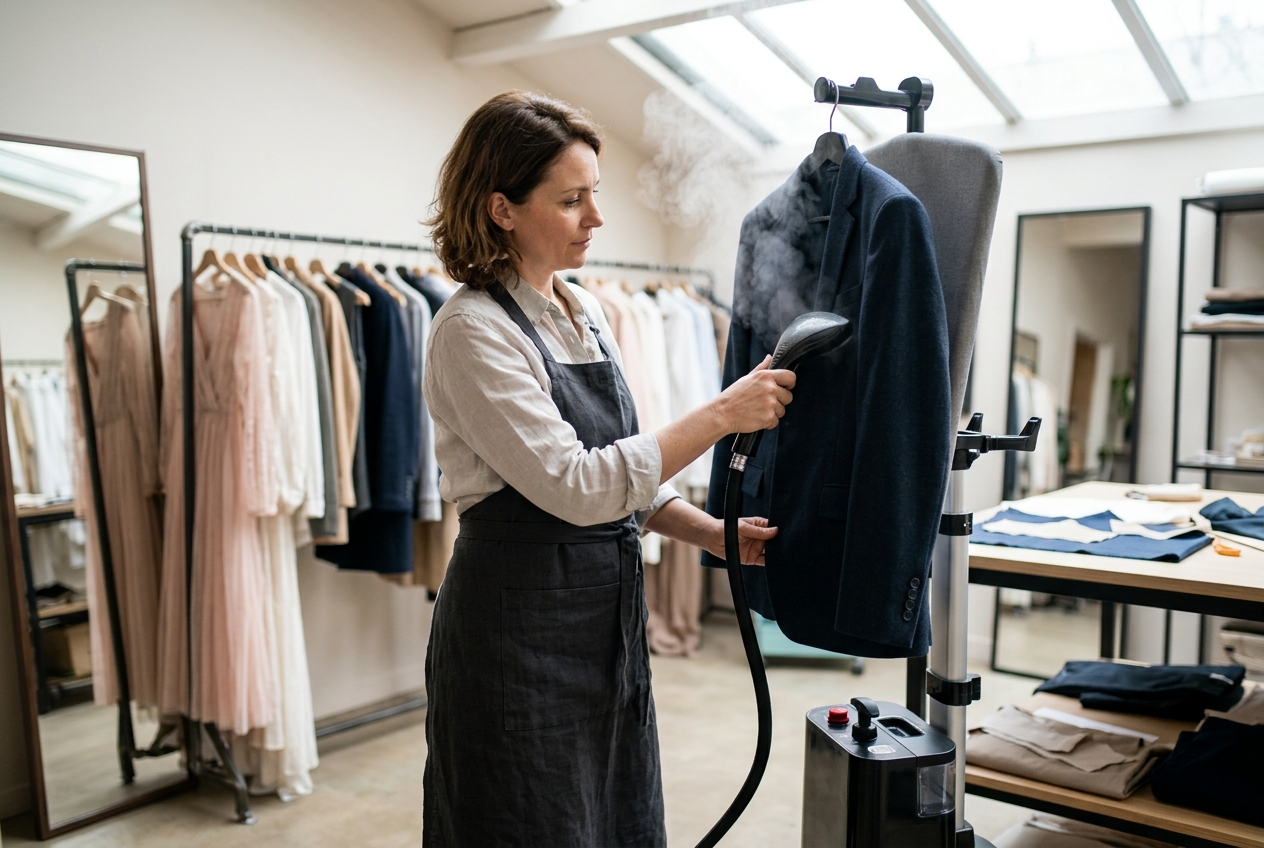
Vertical steaming of a suit jacket on a hanger in a fashion workshop

How does a clothes steamer work? The thermo-hydric principle

Unlike an iron, which relies on mechanical force (flattening through the weight and friction of a hot soleplate), a clothes steamer works through heat transfer and immediate moisture input.

As it passes through the fabric, water vapour (between 98 °C and over 140 °C depending on whether it comes from a continuous flow or a pressurised boiler) penetrates to the core of the yarn. Heat combined with water molecules temporarily breaks the hydrogen bonds that hold the fibre in a creased state. Suspended vertically, the garment regains its natural alignment and three-dimensional structure under its own weight, without any abrasive stress.

Which garments and textiles can be treated with steam?

The absence of direct mechanical pressure makes steam compatible with almost the entire wardrobe, including fabrics on which a traditional iron is strictly unsuitable:

  • Fine and delicate fibres: silk, chiffon, cashmere, alpaca, velvet and heat-sensitive synthetics (viscose, polyester) that may melt or develop shine under a hot soleplate.
  • Structured garments: suit jackets, shoulder pads, permanent pleats, ruffled dresses or embroidery that cannot be laid flat on an ironing board.
  • Furnishing textiles: curtains and sheers on their rail, upholstered headboards, sofas and stretched fabrics.

Precautions: Only genuine leather, suede and non-breathable coated or waterproof fabrics should not be exposed to direct steam.

Clothes steamer or iron: the end of the compromise

For a long time, the vertical steamer was seen as a simple supplementary appliance, unable to match the crisp finish of an iron on washed and machine-spun garments. This limitation came from the technology used:

  • Continuous low pressure (free-flow steam): ideal for removing transport creases from new garments in retail, but limited on thick cotton spun at 1,200 rpm.
  • High-pressure boiler steam: by driving steam through the fabric at 4 to 5 bar, it competes directly with the best steam-generator irons.

Today, a hybrid high-pressure station such as the Gecko-Steamer MP900 combines the best of both worlds: the speed of vertical steaming on a hanger and the precision of flat work on an integrated board for collars and trouser creases.

The objective advantages of vertical steaming

  • Total fabric preservation: eliminates the risk of glazing (shiny marks on wool and dark suits) and crushing seams.
  • Operational time saving: fast start-up (45 seconds to 3 minutes depending on boiler architecture) and direct work without setting up a heavy ironing board.
  • Natural hygienic action: the steam outlet temperature helps remove embedded odours (tobacco, perspiration, cooking) and neutralises dust mites and bacteria without chemical additives.
  • Working ergonomics: a natural standing posture reduces back strain associated with prolonged ironing on a board.

Technique guide: how to steam properly

  1. Water preparation: for high-pressure models with a sealed boiler, use only demineralized water for steam generators. For low-pressure models with a removable tank, tap water is accepted subject to regular periodic descaling.
  2. Positioning: hang the garment straight on a rigid hanger or on the integrated hanger of your telescopic pole.
  3. Passing technique: place the soleplate in light contact with the fabric. Move slowly from top to bottom while keeping slight tension on the lower part of the garment with your free hand.
  4. Condensate evacuation: at start-up, hold the hose vertically for a few seconds so any condensation droplets can run back toward the base before approaching the fabric.

Discover the Gecko-Steamer® ranges according to your use

Choosing equipment should never be random: it must match the mechanical reality of your textiles.

  • For the home (to replace ironing): discover our home clothes steamer range, including the hybrid MP900 high-pressure station with multi-position board.
  • For fashion retail (intensive use): browse our selection of professional clothes steamers with continuous low-pressure flow, designed for uninterrupted output with reduced limescale constraints.
  • For curtains, upholsterers and heavy textiles: the high-pressure Gecko-Steamer G800 with long diffuser provides the power required for work at height and on thick furnishing fabrics.

Technical frequently asked questions

Can a clothes steamer completely replace an iron?

A conventional low-pressure vertical steamer does not replace an iron on heavily spun, machine-washed laundry. A high-pressure station (4 to 5 bar) with a heated soleplate and tilting board such as the MP900 can, however, fully replace a steam generator by handling everyday laundry flat as well as delicate garments vertically.

Which fabrics should not be steamed?

Genuine leather, suede and non-breathable coated materials should not be exposed to water vapour. Virgin wool, natural silk, cashmere, linen and technical fibres are, however, perfectly suitable for vertical steaming.

What water should be used in a clothes steamer?

On high-pressure appliances (sealed boiler or conductivity sensor), always use demineralized water specially formulated for steam appliances to prevent limescale without disturbing the level sensor. On continuous low-pressure models, tap water is accepted provided a monthly rinse and descaling with 14° household white vinegar is carried out.

How do you steam curtains that are already installed?

To treat sheers or hanging curtains without removing them, use a high-pressure steamer equipped with a lance or telescopic-pole diffuser such as the G800. Boiler pressure projects steam upward without loss of heat or water spitting.

What is the difference between a retail steamer and a home model?

In retail, the garments are new and unpacked, and have never been washed: continuous low pressure with non-stop refilling is the fastest and most economical solution. At home, textiles have been through the washing-machine drum and spin cycle: only high-pressure boiler steam has the energy needed to open compressed fibres.